
Case study2024BST Consulting
IFRS 9 Engine.
A full expected-credit-loss engine deployed to three Nigerian banks.
- Period
- 2024 to Present
- Role
- Programme Manager
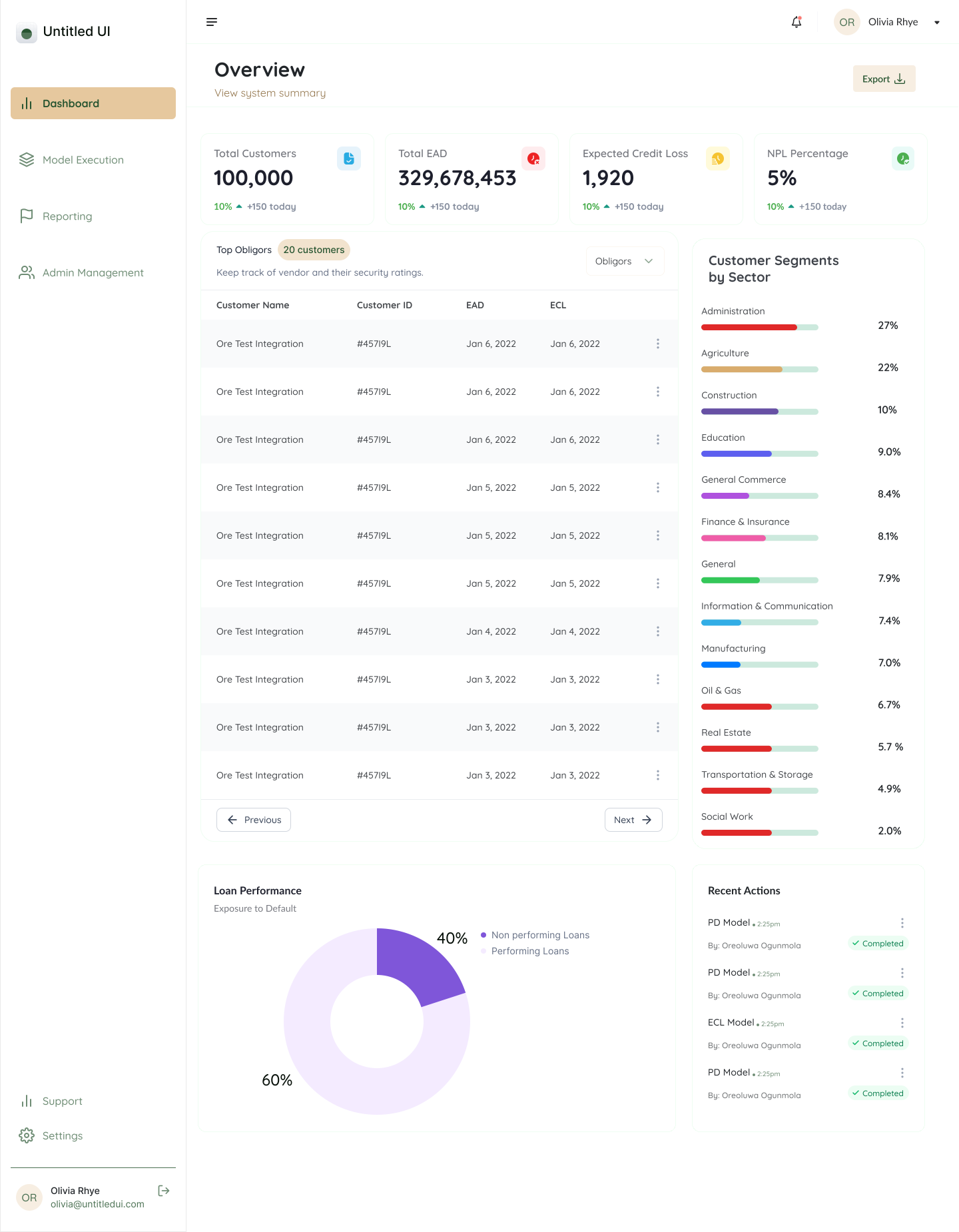
Snapshot.
An IFRS 9 expected credit loss engine deployed to three Nigerian banks, SunTrust Bank, Wema Bank, and Tatum Bank. The system runs a full suite of credit risk models: CCF for off-balance-sheet conversion, EAD projections, PD staging models, LGD with CBN-accepted collateral haircuts, scenario-weighted ECL (Base/Best/Worse), and a forward-looking information module. Every run produces audit-ready documentation automatically.
My role.
Programme Manager
Problem context.
IFRS 9 ECL reporting at most Nigerian banks lived in analyst-owned spreadsheets. Reproducing a quarterly number was slow and error-prone. Auditors requested documentation that no one had centrally maintained. Parameter drift between quarters went undetected until review, and each bank had its own variant of the same calculation, making firm-wide quality control impossible.
Decisions and execution.
For SunTrust Bank, the first deployment I fully led, I embedded with the risk modelling team to lift the calculation surface out of workbooks and into a versioned API. Scenario weightings were made declarative and auditable rather than buried in macros. Audit documentation was co-authored alongside the models so every run generated a complete compliance pack. Subsequent deployments for Wema Bank and Tatum Bank adapted the engine to each bank's collateral mix and staging thresholds while keeping the core architecture consistent.
Outcome.
Three banks now run IFRS 9 ECL with a consistent, audit-ready engine. Each deployment ships with documentation already attached. Risk teams stopped spending cycles reconciling parameter drift and could focus on modelling credit quality instead.
What I would improve next.
Risk modellers need to stay in control of their own parameters. The right platform surface lets them tune without losing versioning, lineage, and governance, not choose between the two.